The story of The Nutcracker
The Nutcracker is about, well, yes, it’s a story of a nutcracker doll. Or rather the story of the little girl that gets it. Sounds incredibly fascinating, doesn’t it? Well, let’s go.
We’re set at a christmas party at the Stahlbaums’. Clara, the daughter of the Stahlbaums’ (such a catchy name!), and her brother Fritz are running around the prominent guests, until their mystical godfather Herr Drosselmeyer arrives the party, fashionable late. Charming as always, he brings gifts for all the kids, Clara get’s a nutcracker doll. Fritz gets jealous of Clara’s new toy, and brakes it, but Herr Drosselmeyer, now also handyman, fixes it with a handkerchief. He also bring three real-sized dolls, that does their little dance, to great amusement for both kids, party members and (supposedly) to the audience. In some versions of the ballet, he also plays a puppet-show, telling the tale of the ballet to come. What a spoiler!
As the party end, the Stahlbaums’ retire to their bedrooms. Clara sneaks out of bed to watch her new toy again, and just as the clock strikes midnight, the christmas tree grows enormous, and a bunch of evil mice, led by their Mice King, appears. The nutcracker also comes to life, and with his band of soldiers, they are protecting Clara from the evil mice. A battle of huge (or was it tiny?) dimensions is fought, until finally Clara throws her shoe at the Mice King, killing him instantly (those pointe shoes, you know. Hard as hell). In some versions, this only paralyses the Mice King long enough for the Nutcracker to stab him to death. Bottom line is: evil mice king dies, and the other mice retreat the battle. Victory is a fact.
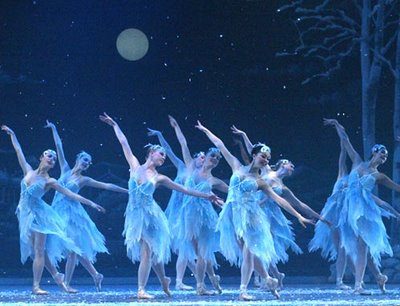
Upon defeating the mice king, Clara and her nutcracker prince (his name may actually be nothing less than Prince Coqueluche, but there’s some confusion going on here, I’ll explain it all later. Let’s just stick to Prince for now, shall we?) goes for a travel to another world where dancing snowflakes and fairies awaits. Curtain falls. Time for some snacks.
Prince-Problem: Depending on what story one follow, you might have a little prince-problem following the Nutcracker plot. Let’s clear things up: In the original tale by E.T.A Hoffmann, the Sugar Plum Fairy has no partner or prince. The Nutcracker only turns into a prince at the end of the tale, and marries Clara (or Mairie, as she is called Hoffmanns tale). No problem. But for staging a ballet, they needed a prince to partner S-P-Fairy. This cavalier was named prince Coqueluche, and is therefore not the same prince as the Nutcracker doll turns into, but a separate prince. In this variation of the plot, the Nutcracker in human form is called simply Nutcracker prince. Problems comes in those versions where the Nutcracker prince it is the same dancer/character doing the grand pas de deux with Sugar Plum Fairy, hence Prince Coqueluche. Is the dancer shaping two different roles in one performance, or is the Nutcracker Prince in fact having an affair? Since this is all just a result of the fantasy of a little girl, I think we’ll pend it on just a slight confusion on her behalf. After all, she has been traveling to alternate worlds, and seen live snowflakes and whatsnot. Not to forget that she snuck out of bed, hence not sleeping a second tonight, no wonder if she mixes up the character-gallery a bit.
Want to read more Bedtime Stories? Click here
Rehearsing the Nutcracker is the cause of a SYTYCD-disease known as Cracked Nuts disorder
Cracked facts:
Premiered on 18th of December, 1892, as a double bill with a less famous Tchaikovsy opera, Iolanta.
Plot: Based E.T.A. Hoffmanns tale “The Nutcracker and the Mouse King”. The original story apparently is much more complex (doesn’t take much). The piece is typically staged around Christmas, and has become a tradition for families all over the world.
Choreography: Marius Petipa – or? Petipa started the choreography, but got sick, and his assistant, Lev Ivanov, continued the work. The latter was earlier often credited as the choreographer, although it is under Petipa’s famous name the piece is usually credited today).
Music: Pyotr Ilyich Tchaikovsky. Before the ballets premiere in 1892, Tchaikovsky selected 8 numbers from the score, and put them together in a suite intended for concert performance. He named it The Nutcracker Suite, op. 71a. It was first performed under his own conduction in march 1982 (ballet premiered in december), and became instantly popular. This has most of the honor for the music being so internationally famous, as the ballet itself didn’t really become popular until much later. The piece is noted for it’s use of the instrument Celesta (a picking type piano), giving the “Dance of the Sugar Plum Fairy” it’s typical ring. Celesta is also used elsewhere in the second act.


{ 3 comments… read them below or add one }
Henrik–you are so fun to read! I love this new category and can’t wait for the next one!
ЎHola!
,
Ilias
{ 7 trackbacks }